

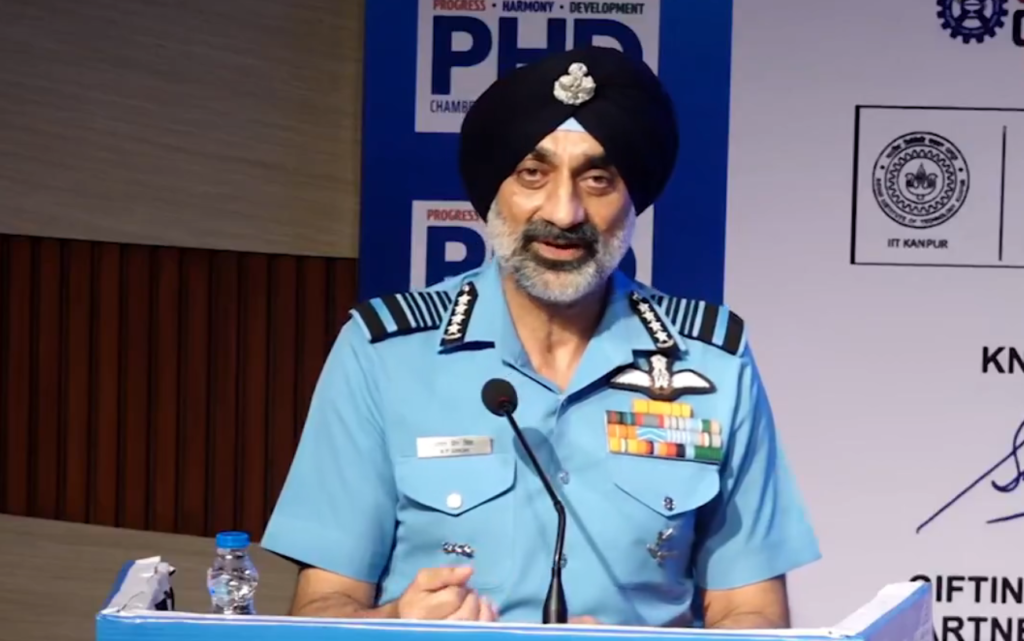
The Indian Air Force (IAF) Chief, Air Chief Marshal Amar Preet Singh, recently emphasized the urgent need for India to develop its drone ecosystem during the inaugural session of the Bharat Drone & Robotics Manthan 3.0 conference. He outlined a strategic vision that prioritizes collaboration with domestic industries to bolster the nation’s self-reliance in defense technologies.
As modern warfare evolves, the demand for cost-effective unmanned systems rises. The Air Chief insisted that India’s defense sector must keep pace with emerging technologies, warning that delays could incur hefty operational costs for the nation.
“The responsibility of outlining precise operational requirements lies squarely with the user,” Singh stated, referring to the importance of the Directorate of Aerospace Design (DAD). This new initiative aims to directly engage with startups and innovators, fostering an environment where defense needs can be explicitly communicated.
“The problem statement has to originate from us. We have the Directorate of Aerospace Design to interact with the industry, startups, and anybody who wants to know what the requirement is, what kind of drones, equipment, or sensors we are looking for,” he elaborated.
To expedite the development of drone technology, the IAF unveiled the Dronathon 2026, set for September, inviting companies to demonstrate their products live rather than relying on traditional paper presentations. This approach highlights a shift towards agility in the evaluation process and calls for innovative solutions from the domestic market.
Stressing the vulnerabilities associated with foreign supply chains, Singh asserted, “Every brick should be developed in India. Then only we can say we are fully Atmanirbhar.” This emphasis on local production marks a significant step toward achieving self-sufficiency in critical defense technologies.
Singh also cautioned against bureaucratic delays in technology deployment, stating, “Technology delayed is technology denied.” He championed a collective effort, urging collaboration among academia, regulators, investors, and manufacturers to transform laboratory solutions into practical applications on the battlefield.
While highlighting that drones will complement manned platforms rather than replace them, the Air Chief’s proactive outreach represents a paradigm shift in the defense sector. It creates collaborative opportunities for India’s growing aerospace entrepreneurs to address operational challenges effectively.
“If we keep doing what we are doing, we will get the same results that we have been getting. If we want different results… let us do something different,” Singh concluded. His call to action resonates as a rallying cry for innovation in aligning India’s defense capabilities with its aspirations for Atmanirbhar Bharat.